

Correlation Between Bone Scintigraphy and Tumor Markers in Patients with Breast Carcinoma
Abstract
A characteristic feature of many cancer types is their ability to metastasise to the skeleton. Bone is the most common site of metastatic invasion, after hematogenous spreading of breast cancer. Early detection of bone metastases is mandatory in the evaluation and management of these patients. Bone scintigraphy is commonly performed in detection and evaluation bone metastases. Tumor markers are present in healthy individuals as well as in patients with malignant diseases but in different concentration. Aim of study was to correlate serum levels of tumor marker Ca (15-3), CEA and presence of bone metastases detected by bone scintigraphy. Study included 25 patients with breast cancer, previously surgically treated. All patients underwent whole body scintigraphy. Ca (15-3) and CEA was measured by radioimmunoassay. Presence, number of bone metastases were correlated with Ca (15-3) and CEA levels. Median age of patients included in study was 50 varying from 30 to 67. Bone scintigraphy revealed bone metastases in 16 (64%) patients. A weak correlation was found between number of metastases and level of Ca (15-3) (r=0.139, p=0.254). Significant differences in Ca (15-3) level was found in patient with metastases compared to patients without metastases (chi square 0, p=1.0). Good correlation was found between number of metastases and serum level of CEA. Correlation between level of two tumor markers Ca (15-3) and CEA was a weak (r = 0.096 , p=0.323). Bone scintigraphy is a sensitive diagnostic toll for detecting breast cancer metastases to bone. Serum levels of tumor markes in isolation can not give complete accuracy about bone metastases.
Keywords
bone metastases breast cancer bone scintigraphy Ca 15-3 CEAFull text
Introduction
A characteristic feature of many cancer types is their ability to metastasise to the skeleton (1). Bone is the most common site of metastatic invasion, after hema-togenous spreading of breast cancer. Early detection of bone metastases is mandatory in the evaluation and managament of this patients. This is of clinical importance as metastatic bone disease is associated with increased morbidity and excess mortality (2, 3, 4). Today there are several procedures and tests available in diagnosis of breast cancer metastases. These investigations are aimed to: establish location of dissemination, make a specific diagnosis, prevent complications by early diagnosis and finally to assess patients response on treatment (5). Bone scintigraphy is most commonly performed procedures in detection and evaluation of bone metastases. This investigation allows detection of osteoblastic activity with high sensitivity. Tumor markers are present in healthy individuals as well as in patients with malignant diseases but in different concentration. In brest cancer, breast-associated mucin marker Ca 15-3 is widely accepted as a serum tumor marker in follow-up and detection of disease recurrence (5, 6). Carcinoembrionalni antigen-CEA is protein found in many types of tumors and the developing fetus. The main use of CEA as tumor marker, especially with intenstinal cancer. CEA is also used in patient with breast and lung cancer (7).
Patients and methods
Twenty five patients with pathologically proven and previously surgically treated brest cancer were included in study. All patients underwent whole body scintigraphy using double-head gamma camera equiped with low energy high resolution collimator 3 hours after I.V. injection of 740MBq Tc-99m MDP (methylen diphosponate). Ca 15-3 and CEA were measured by radioimmunoassay using microparticle Enzym-Immunoassay tehnology, (MEIA, Abbott AXSYM system). Statistical analyses were performed with chi-square test, Student t-test, standard deviation. Study was approved by Ethical Committee and informed consent in writen was obtained from all subjects in advance.
Results
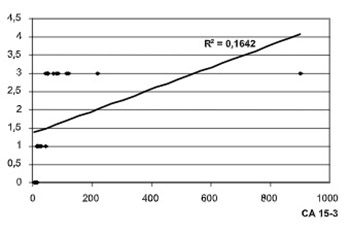
Median age of patients included in study was 50 (Graph 1). Bone scintigraphy was positive in 16 (64%) patients. Scintigraphy was negative for bone metastases in 9 (36%) patients. In 16 patients with positive bone scintigraphy for metastases 11 (68%) patients had elevated level of Ca15-3 and CEA (Table 1). A weak correlation was found between number of metastases and level of Ca 15-3 (r=0.139) (Graph 2). However, statistically significant differences was found in patient with bone metastases revealed scintigraphicallay and level of Ca15-3 in relation with patients without bone metastases (chi square 0, p=1,0) Correlation between number of metastases found by bone scintigraphy and level of tumor marker CEA was positive (r=0,356, p=0,041) (Graph 3). Correlation between level of two tumor markers Ca15-3 and CEA was a weak (r = 0,096, p = 0,323) (Graph 4).
Discussion
Bone scintigraphy as diagnostic method, has found place in many algorithms. Bone scintigraphy is sensitive for many abnormality in bone that causes an osteoblasic reaction, yet it is rather unspecific. The reasons for the success of bone scintigraphy are: the procedure is simple, relatively cheap and reliably provides relevant clinical information in the aerly phase where radiographs are frequently still normal (8). Clinical areas in which the bone scan has been evaluated include staging, systematic follow-up of asimptomatic patients, and assessment of response to therapy (2). Tumor marker sensitivity is also related to the site of recurrence, with the lowest sensitivity for locoregional relapse and highest for liver metastases (9). A rising Ca 15-3 level can detect recurrence after primary treatment, but it is not jet clear if using this test affects survival or quality of life for women with breast cancer. There can also be false positives(positive results in women with no cancer). The disease extent of patients with bone metastases correlated significantly with high Ca 15-3 levels. There were higher Ca 15-3 levels for larger disease extent (9, 10). In our study we found significantly higher levels of Ca 15-3 in patients presented with bone metastases, however, we found no significant correlation betwen level of Ca 15-3 and number of bone metastases. Tumor markers are useful tools for the early diagnosis of metastases, being the first sign of recurrence in 69,5 % of patients with relapse (76,3% in patients with metastases) (10, 11). Although serial tumor marker measurements are an efficient and cost effective method of monitoring disease progresion, it does not allow prediction of the bone scan results, so it is not justifiable to reject a bone scintigraphy on the basis of these markers. In our study we found good correlation between bone metastases and serum level of CEA. We found no significant correlation between two tumor markers Ca15-3 and CEA in patiens with breast carcinoma.
References
- Andreas P, Chritqau S, Lyubi N, et al. Breast cancer patients with bone metastases are characterised by increased levels of nonisomer-ised type I collagen fragments. Breast Cancer Res 2003;5:R103–R109.
- Galasko CSB. Tumors. Radio-nuclide scintigraphy in orthopedics 1984:65–110.
- Coleman RE, Rubens RD. The clinical course of bone metastases from breast cancer. Br. J. Cancer 1987;55:61–66.
- Richards MA, Braysher S, Gregory WM, et al. Advanced breast cancer: use of resources and cost complications. Br. J. Cancer 1993;67:856–860.
- Gary J.R.C, Fogelman I. Skeletal metastases from breast cancer: Imaging with nuclear medicine in seminars in nuclear medicine. 1999.
- Shering SG, Sherry F, Mc Dermott EW, O’Higgins NJ. Preopera-tive Ca15-3 concentrations predict outcome of patients with breast carcinoma. Cancer 1998;83(12):2521–2527.
- Jager PL. Bone scintigraphy in ocology. J. Postgrad. Med 2004;50:183–184.
- Bombardieri E, Pizzichetta M, Veronesi P, et al. Ca 15-3 determination in patients with breast cancer. Clinical utility for the detection of distant metastases. Eur. J. Cancer 1993;29A:144–146.
- Tarkan K, Nazan G, Zafer A. The use of Ca 15-3 and estrogen receptor in breast cancer patients with bone metastases. Gazi Med. J 1998;9:149–153.
- Molina R, Jo J. C-erB-2, CEA and Ca 15.3 serum levels in the early diagnosis of recurrence of breast cancer patients. Anticancer Res 1999;19(4A):2551–2555.
- Yildiz M, Oral B, Bozkurt M, Cobaner A. Relationship between bone scintigraphy and tumor markers in patients with breast cancer. Annals of Nuclear Medicine 2004;18(6):501–505.
About this article
Correspondence
*Corresponding author
Copyright
Copyright: © 2006 ABMSFBIH
Downloads
References
Andreas P, Chritqau S, Lyubi N, et al. Breast cancer patients with bone metastases are characterised by increased levels of nonisomer-ised type I collagen fragments. Breast Cancer Res. 2003;5:R103-R109. DOI: https://doi.org/10.1186/bcr607
Galasko CSB, Galasko CSB, Weber Da. Tumors. Radio-nuclide scintigraphy in orthopedics. 1984:65-110.
Coleman RE, Rubens RD. The clinical course of bone metastases from breast cancer. Br. J. Cancer. 1987;55:61-66. DOI: https://doi.org/10.1038/bjc.1987.13
Richards MA, Braysher S, Gregory WM, et al. Advanced breast cancer: use of resources and cost complications. Br. J. Cancer. 1993;67:856-860. DOI: https://doi.org/10.1038/bjc.1993.157
Gary J.R.C, Fogelman I. Skeletal metastases from breast cancer: Imaging with nuclear medicine in seminars in nuclear medicine. 1999;XXXIX(No 1):69-79. DOI: https://doi.org/10.1016/S0001-2998(99)80031-2
Shering SG, Sherry F, Mc Dermott EW, O’Higgins NJ. Preopera-tive Ca15-3 concentrations predict outcome of patients with breast carcinoma. Cancer. 1998;83(12):2521-2527. DOI: https://doi.org/10.1002/(SICI)1097-0142(19981215)83:12<2521::AID-CNCR17>3.0.CO;2-A
Jager PL. Bone scintigraphy in ocology. J. Postgrad. Med. 2004;50:183-184.
Bombardieri E, Pizzichetta M, Veronesi P, et al. Ca 15-3 determination in patients with breast cancer. Clinical utility for the detection of distant metastases. Eur. J. Cancer. 1993;29A:144-146. DOI: https://doi.org/10.1016/0959-8049(93)90595-7
Tarkan K, Nazan G, Zafer A. The use of Ca 15-3 and estrogen receptor in breast cancer patients with bone metastases. Gazi Med. J. 1998;9:149-153.
Molina R, Jo J. C-erB-2, CEA and Ca 15.3 serum levels in the early diagnosis of recurrence of breast cancer patients. Anticancer Res. 1999;19(4A):2551-2555.
Yildiz M, Oral B, Bozkurt M, Cobaner A. Relationship between bone scintigraphy and tumor markers in patients with breast cancer. Annals of Nuclear Medicine. 2004;18(6):501-505. DOI: https://doi.org/10.1007/BF02984567
Article files
Additional Files
Accepted 2018-02-19
Published 2006-02-20
Publication details
- Citation
- Vol. 6 No. 1 (2006), pp. 75-77
- Language
- EN
- Section
- Biochemistry
How to cite (Vancouver)
Begić A, Kučukalić-Selimović E, Obralić N, Durić O, Lačević N, Skopljak A. Correlation Between Bone Scintigraphy and Tumor Markers in Patients with Breast Carcinoma. Biomol Biomed. 2006;6(1):75-77. https://doi.org/10.17305/bjbms.2006.3216