

C-reactive protein, rather than pyuria, may help differentiate asymptomatic bacteriuria from symptomatic urinary tract infection
Abstract
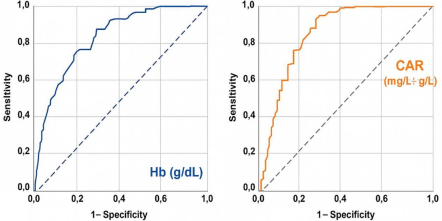
Distinguishing asymptomatic bacteriuria (ASB) from symptomatic urinary tract infection (UTI) may reduce unnecessary antibiotic use. We retrospectively compared admission C-reactive protein (CRP), urinary leukocyte count, and hematologic indices in 400 consecutive episodes of significant bacteriuria in 337 adults referred to an infectious diseases service between January 2021 and June 2026. Two investigators independently applied Infectious Diseases Society of America (IDSA) criteria to documented symptoms; bacteremia concordant with the urine isolate indicated infection. Analyses used areas under the receiver operating characteristic (ROC) curves (AUCs), patient-level cluster-bootstrap confidence intervals (CIs), and multivariable logistic regression. ASB accounted for 154 episodes (38.5%); baseline characteristics were broadly similar between groups. All ASB episodes received antibiotics (median 11 days; 1,778 antibiotic-days); 47 of 95 with bacterial isolates (49.5%) involved resistant organisms. CRP had an AUC of 0.892 (95% CI 0.858–0.923), outperforming the neutrophil-to-lymphocyte ratio (NLR; 0.714), procalcitonin (0.672), systemic immune-inflammation index (SII; 0.580), and platelet-to-lymphocyte ratio (PLR; 0.441; all comparisons p < 0.001). Urinary leukocyte count did not discriminate (AUC 0.482; 95% CI 0.429–0.539). CRP discrimination was lower against localized than systemic UTI (AUC 0.784 vs. 0.915). Below 5 mg/L, 3 of 46 episodes were symptomatic UTI (negative predictive value [NPV] 93.5%; 95% CI 82.5–97.8%). Among modeled inflammatory markers, only CRP was independently associated with symptomatic UTI (adjusted odds ratio [OR] 8.05 per log unit). Platelet counts were higher in ASB (272 vs. 243 ×10³/µL; p = 0.003), potentially explaining weaker performance of platelet-containing indices than NLR alone. In this retrospective cohort, admission CRP showed good discrimination between episodes classified as ASB and symptomatic UTI, whereas pyuria did not. The low-CRP threshold requires prospective validation before guiding antibiotic withholding.
Keywords
Bacteriuria C-reactive protein pyuria urinary tract infections antimicrobial stewardship biomarkers sensitivity and specificityDownloads
References
Nicolle LE, Gupta K, Bradley SF, Colgan R, DeMuri GP, Drekonja D, et al. Clinical practice guideline for the management of asymptomatic bacteriuria: 2019 update by the Infectious Diseases Society of America. Clin Infect Dis. 2019;68(10):e83–110. https://doi.org/10.1093/cid/ciy1121 DOI: https://doi.org/10.1093/cid/ciy1121
Köves B, Cai T, Veeratterapillay R, Pickard R, Seisen T, Lam TB, et al. Benefits and harms of treatment of asymptomatic bacteriuria: a systematic review and meta-analysis by the European Association of Urology Urological Infection Guidelines Panel. Eur Urol. 2017;72(6):865–8. https://doi.org/10.1016/j.eururo.2017.07.014 DOI: https://doi.org/10.1016/j.eururo.2017.07.014
Antimicrobial Resistance Collaborators. Global burden of bacterial antimicrobial resistance in 2019: a systematic analysis. Lancet. 2022;399(10325):629–55. https://doi.org/10.1016/S0140-6736(21)02724-0 DOI: https://doi.org/10.1016/S0140-6736(21)02724-0
GBD 2021 Antimicrobial Resistance Collaborators. Global burden of bacterial antimicrobial resistance 1990–2021: a systematic analysis with forecasts to 2050. Lancet. 2024;404(10459):1199–226. https://doi.org/10.1016/S0140-6736(24)01867-1 DOI: https://doi.org/10.1016/S0140-6736(24)01867-1
Petty LA, Vaughn VM, Flanders SA, Malani AN, Conlon A, Kaye KS, et al. Risk factors and outcomes associated with treatment of asymptomatic bacteriuria in hospitalized patients. JAMA Intern Med. 2019;179(11):1519–27. https://doi.org/10.1001/jamainternmed.2019.2871 DOI: https://doi.org/10.1001/jamainternmed.2019.2871
Spivak ES, Burk M, Zhang R, Jones MM, Neuhauser MM, Goetz MB, et al. Management of bacteriuria in Veterans Affairs hospitals. Clin Infect Dis. 2017;65(6):910–7. https://doi.org/10.1093/cid/cix474 DOI: https://doi.org/10.1093/cid/cix474
Vaughn VM, Gupta A, Petty LA, Malani AN, Osterholzer D, Patel PK, et al. A statewide quality initiative to reduce unnecessary antibiotic treatment of asymptomatic bacteriuria. JAMA Intern Med. 2023;183(9):933–41. https://doi.org/10.1001/jamainternmed.2023.2749 DOI: https://doi.org/10.1001/jamainternmed.2023.2749
van Horrik TMZXK, Laan BJ, Stalenhoef JE, van Nieuwkoop C, Saanen JB, Schneeberger C, et al. De-implementation strategy to reduce overtreatment of asymptomatic bacteriuria in the emergency department: a stepped-wedge cluster randomised trial. Ther Adv Infect Dis. 2024;11:20499361241293687. https://doi.org/10.1177/20499361241293687 DOI: https://doi.org/10.1177/20499361241293687
Krinitski D, Kasina R, Klöppel S, Lenouvel E. Associations of delirium with urinary tract infections and asymptomatic bacteriuria in adults aged 65 and older: a systematic review and meta-analysis. J Am Geriatr Soc. 2021;69(11):3312–23. https://doi.org/10.1111/jgs.17418 DOI: https://doi.org/10.1111/jgs.17418
Hu B, Yang XR, Xu Y, Sun YF, Sun C, Guo W, et al. Systemic immune-inflammation index predicts prognosis of patients after curative resection for hepatocellular carcinoma. Clin Cancer Res. 2014;20(23):6212–22. https://doi.org/10.1158/1078-0432.CCR-14-0442 DOI: https://doi.org/10.1158/1078-0432.CCR-14-0442
Bonkat G, Wagenlehner F, Cai T, Geerlings S, Medina-Polo J, Köves B, et al. Classification of urinary tract infections in 2025: moving beyond uncomplicated and complicated. Eur Urol Open Sci. 2025;75:44–7. https://doi.org/10.1016/j.euros.2025.03.010 DOI: https://doi.org/10.1016/j.euros.2025.03.010
Kranz J, Bartoletti R, Bruyère F, Cai T, Geerlings S, Köves B, et al. European Association of Urology guidelines on urological infections: summary of the 2024 guidelines. Eur Urol. 2024;86(1):27–41. https://doi.org/10.1016/j.eururo.2024.03.035 DOI: https://doi.org/10.1016/j.eururo.2024.03.035
Klinik Mikrobiyoloji Uzmanlık Derneği. Üriner sistem örneklerinin laboratuvar tanısı rehberi. 2nd ed. Ankara: KLİMUD; 2020. p. 31–33. Turkish. Available from: https://klimud.org/uploads/content/%C3%9Criner%20Sistem%20%C3%96rneklerinin%20Laboratuvar%20Tan%C4%B1s%C4%B1%20(Ver2.1-2020).pdf
Bossuyt PM, Reitsma JB, Bruns DE, Gatsonis CA, Glasziou PP, Irwig L, et al. STARD 2015: an updated list of essential items for reporting diagnostic accuracy studies. BMJ. 2015;351:h5527. https://doi.org/10.1136/bmj.h5527 DOI: https://doi.org/10.1136/bmj.h5527
Kidney Disease: Improving Global Outcomes (KDIGO) Acute Kidney Injury Work Group. KDIGO clinical practice guideline for acute kidney injury. Kidney Int Suppl. 2012;2(1):1–138.
Závada J, Hoste E, Cartin-Ceba R, Calzavacca P, Gajic O, Clermont G, et al. A comparison of three methods to estimate baseline creatinine for RIFLE classification. Nephrol Dial Transplant. 2010;25(12):3911–8. https://doi.org/10.1093/ndt/gfp766 DOI: https://doi.org/10.1093/ndt/gfp766
Magiorakos AP, Srinivasan A, Carey RB, Carmeli Y, Falagas ME, Giske CG, et al. Multidrug-resistant, extensively drug-resistant and pandrug-resistant bacteria: an international expert proposal for interim standard definitions for acquired resistance. Clin Microbiol Infect. 2012;18(3):268–81. https://doi.org/10.1111/j.1469-0691.2011.03570.x DOI: https://doi.org/10.1111/j.1469-0691.2011.03570.x
Riley RD, Snell KIE, Ensor J, Burke DL, Harrell FE Jr, Moons KGM, et al. Minimum sample size for developing a multivariable prediction model: part II – binary and time-to-event outcomes. Stat Med. 2019;38(7):1276–96. https://doi.org/10.1002/sim.7992 DOI: https://doi.org/10.1002/sim.7992
Riley RD, Van Calster B, Collins GS. A note on estimating the Cox-Snell R² from a reported C statistic (AUROC) to inform sample size calculations for developing a prediction model with a binary outcome. Stat Med. 2021;40(4):859–64. https://doi.org/10.1002/sim.8806 DOI: https://doi.org/10.1002/sim.8806
Morgan DJ, Malani P, Diekema DJ. Diagnostic stewardship – leveraging the laboratory to improve antimicrobial use. JAMA. 2017;318(7):607–8. https://doi.org/10.1001/jama.2017.8531 DOI: https://doi.org/10.1001/jama.2017.8531
Lee MJ, Kim M, Kim NH, Kim CJ, Song KH, Choe PG, et al. Why is asymptomatic bacteriuria overtreated?: a tertiary care institutional survey of resident physicians. BMC Infect Dis. 2015;15:289. https://doi.org/10.1186/s12879-015-1044-3 DOI: https://doi.org/10.1186/s12879-015-1044-3
Drekonja DM, Abbo LM, Kuskowski MA, Gnadt C, Shukla B, Johnson JR. A survey of resident physicians' knowledge regarding urine testing and subsequent antimicrobial treatment. Am J Infect Control. 2013;41(10):892–6. https://doi.org/10.1016/j.ajic.2013.01.020 DOI: https://doi.org/10.1016/j.ajic.2013.01.020
Grigoryan L, Naik AD, Horwitz D, Cadena J, Patterson JE, Zoorob R, et al. Survey finds improvement in cognitive biases that drive overtreatment of asymptomatic bacteriuria after a successful antimicrobial stewardship intervention. Am J Infect Control. 2016;44(12):1544–8. https://doi.org/10.1016/j.ajic.2016.04.238 DOI: https://doi.org/10.1016/j.ajic.2016.04.238
Trautner BW, Grigoryan L, Petersen NJ, Hysong S, Cadena J, Patterson JE, et al. Effectiveness of an antimicrobial stewardship approach for urinary catheter-associated asymptomatic bacteriuria. JAMA Intern Med. 2015;175(7):1120–7. https://doi.org/10.1001/jamainternmed.2015.1878 DOI: https://doi.org/10.1001/jamainternmed.2015.1878
Grigoryan L, Naik AD, Lichtenberger P, Graber CJ, Patel PK, Drekonja DM, et al. Analysis of an antibiotic stewardship program for asymptomatic bacteriuria in the Veterans Affairs health care system. JAMA Netw Open. 2022;5(7):e2222530. https://doi.org/10.1001/jamanetworkopen.2022.22530 DOI: https://doi.org/10.1001/jamanetworkopen.2022.22530
Advani SD, Ratz D, Horowitz JK, Petty LA, Fakih MG, Schmader K, et al. Bacteremia from a presumed urinary source in hospitalized adults with asymptomatic bacteriuria. JAMA Netw Open. 2024;7(3):e242283. https://doi.org/10.1001/jamanetworkopen.2024.2283 DOI: https://doi.org/10.1001/jamanetworkopen.2024.2283
Stall NM, Kandel C, Reppas-Rindlisbacher C, Quinn KL, Wiesenfeld L, MacFadden DR, et al. Antibiotics for delirium in older adults with pyuria or bacteriuria: a systematic review. J Am Geriatr Soc. 2024;72(8):2566–78. https://doi.org/10.1111/jgs.18964 DOI: https://doi.org/10.1111/jgs.18964
Li X, Fan H, Zi H, Hu H, Li B, Huang J, et al. Global and regional burden of bacterial antimicrobial resistance in urinary tract infections in 2019. J Clin Med. 2022;11(10):2817. https://doi.org/10.3390/jcm11102817 DOI: https://doi.org/10.3390/jcm11102817
Watson KJ, Trautner B, Russo H, Phe K, Lasco T, Pipkins T, et al. Using clinical decision support to improve urine culture diagnostic stewardship, antimicrobial stewardship, and financial cost: a multicenter experience. Infect Control Hosp Epidemiol. 2020;41(5):564–70. https://doi.org/10.1017/ice.2020.37 DOI: https://doi.org/10.1017/ice.2020.37
Advani S, Vaughn VM. Quality improvement interventions and implementation strategies for urine culture stewardship in the acute care setting: advances and challenges. Curr Infect Dis Rep. 2021;23(10):16. https://doi.org/10.1007/s11908-021-00760-3 DOI: https://doi.org/10.1007/s11908-021-00760-3
Article files
Additional Files
Publication details
- Citation
- Advance online
- Language
- EN
- License
- CC BY 4.0
- Section
- Research article
How to cite (Vancouver)
Dalmanoğlu E, Çağlar Y, Yılmaz A. C-reactive protein, rather than pyuria, may help differentiate asymptomatic bacteriuria from symptomatic urinary tract infection. Biomol Biomed. 2026. https://doi.org/10.17305/bb.2026.15190