HCAR score as a prognostic biomarker of survival in locally advanced nasopharyngeal carcinoma treated with concurrent chemoradiotherapy
DOI:
https://doi.org/10.17305/bb.2025.13398Keywords:
Hemoglobins, C-reactive protein, albumins, biomarkers, prognosis, treatment outcomeAbstract
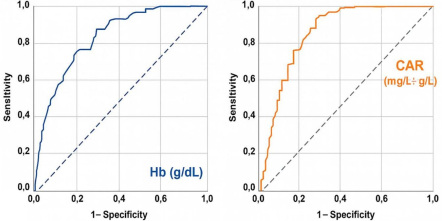
Nasopharyngeal carcinoma (NPC) is an aggressive malignancy of the head and neck that is often diagnosed at a locally advanced stage (LANPC). In such cases, intensity-modulated radiotherapy combined with concurrent chemoradiotherapy (CCRT) is the standard treatment; however, the occurrence of distant metastasis and treatment failure remains prevalent. This study evaluates the prognostic significance of a novel composite score that combines hemoglobin levels and the C-reactive protein-to-albumin ratio (HCAR) in LANPC patients undergoing CCRT. We conducted a retrospective analysis of 233 LANPC patients treated with intensity-modulated radiotherapy and platinum-based CCRT from 2011 to 2020. Receiver operating characteristic curve analysis determined pretreatment hemoglobin (Hb) and C-reactive protein-to-albumin ratio (CAR) cut-offs of 11.0 g/dL and 3.0, respectively, which were utilized to create a three-tiered HCAR score: HCAR-0 (Hb ≥11.0 g/dL and CAR <3.0), HCAR-1 (Hb ≥11.0 g/dL and CAR ≥3.0 or Hb <11.0 g/dL and CAR <3.0), and HCAR-2 (Hb <11.0 g/dL and CAR ≥3.0). The primary endpoint of the study was overall survival (OS), while progression-free survival (PFS) was the secondary endpoint. With a median follow-up of 85.7 months, the median PFS and OS were 66.0 months and 108.0 months, respectively, with 5-year PFS and OS rates of 52.8% and 75.9%. The HCAR score significantly stratified patient outcomes: median PFS was not reached for HCAR-0, 66.0 months for HCAR-1, and 25.0 months for HCAR-2. Median OS also varied significantly, being not reached for HCAR-0, 108.0 months for HCAR-1, and 55.0 months for HCAR-2 (all p < 0.001). Corresponding 10-year PFS rates were 50.2%, 34.4%, and 5.0%, while 10-year OS rates were 68.3%, 41.6%, and 11.1%. Multivariate analysis revealed that the HCAR score remained an independent predictor of both PFS and OS, alongside T and N stage. The HCAR score shows promising prognostic utility for predicting OS and PFS in LANPC; however, performance estimates may be overly optimistic due to the lack of internal validation.
Citations
Downloads
References
Bray F, Ferlay J, Soerjomataram I, Siegel RL, Torre LA, Jemal A. Global cancer statistics 2018: GLOBOCAN estimates of incidence and mortality worldwide for 36 cancers in 185 countries. CA Cancer J Clin 2018;68(6):394–424. https://doi.org/10.3322/caac.21492
Chen YP, Chan ATC, Le QT, Blanchard P, Sun Y, Ma J. Nasopharyngeal carcinoma. Lancet 2019;394(10192):64–80. https://doi.org/10.1016/S0140-6736(19)30956-0
Sung H, Ferlay J, Siegel RL, Laversanne M, Soerjomataram I, Jemal A, et al. Global cancer statistics 2020: GLOBOCAN estimates of incidence and mortality worldwide for 36 cancers in 185 countries. CA Cancer J Clin 2021;71(3):209–249. https://doi.org/10.3322/caac.21660
Su L, She L, Shen L. The current role of adjuvant chemotherapy in locally advanced nasopharyngeal carcinoma. Front Oncol 2021;10:585046. https://doi.org/10.3389/fonc.2020.585046
Liu J, Zeng Z, Wang D, Qin G. Minimally invasive surgery for early-stage nasopharyngeal carcinoma. J Craniofac Surg 2022;33(8):e834–e837. https://doi.org/10.1097/SCS.0000000000008765
Lin JC, Jan JS, Hsu CY, Liang WM, Jiang RS, Wang WY. Phase III study of concurrent chemoradiotherapy versus radiotherapy alone for advanced nasopharyngeal carcinoma. J Clin Oncol 2003;21(4):631–637. https://doi.org/10.1200/JCO.2003.06.158
Baujat B, Audry H, Bourhis J, et al. Chemotherapy in locally advanced nasopharyngeal carcinoma: an individual patient data meta-analysis of eight randomized trials and 1753 patients. Int J Radiat Oncol Biol Phys 2006;64(1):47–56. https://doi.org/10.1016/j.ijrobp.2005.06.037
Yang Q, Cao S, Guo L, et al. Induction chemotherapy followed by concurrent chemoradiotherapy versus concurrent chemoradiotherapy alone in locoregionally advanced nasopharyngeal carcinoma: long-term results of a phase III multicentre trial. Eur J Cancer 2019;119:87–96. https://doi.org/10.1016/j.ejca.2019.07.007
Petit C, Lee A, Ma J, Lacas B, Ng WT, Chan ATC, et al. Role of chemotherapy in patients with nasopharynx carcinoma treated with radiotherapy (MAC-NPC): an updated individual patient data network meta-analysis. Lancet Oncol 2023;24(6):611–623. https://doi.org/10.1016/S1470-2045(23)00163-8
Pan JJ, Ng WT, Zong JF, Chan LL, O’Sullivan B, Lin SJ, et al. Proposal for the 8th edition of the AJCC/UICC staging system for nasopharyngeal cancer in the era of IMRT. Cancer 2016;122(4):546–558. https://doi.org/10.1002/cncr.29795
Au KH, Ngan RKC, Ng AWY, Poon DMC, Ng WT, Yuen KT, et al. Treatment outcomes of nasopharyngeal carcinoma in the modern era after IMRT: report of 3328 patients. Oral Oncol 2018;77:16–21. https://doi.org/10.1016/j.oraloncology.2017.12.015
Li J, Chen S, Peng S, et al. Prognostic nomogram for patients with nasopharyngeal carcinoma incorporating hematological biomarkers and clinical characteristics. Int J Biol Sci 2018;14(5):549–556. https://doi.org/10.7150/ijbs.23311
Mao YP, Xie FY, Liu LZ, et al. Re-evaluation of the 6th AJCC staging system for nasopharyngeal carcinoma based on MRI. Int J Radiat Oncol Biol Phys 2009;73(5):1326–1334. https://doi.org/10.1016/j.ijrobp.2008.06.193
Wang HY, Sun BY, Zhu ZH, et al. Eight-signature classifier for prediction of nasopharyngeal carcinoma survival. J Clin Oncol 2011;29(34):4516–4525. https://doi.org/10.1200/JCO.2010.33.7744
Lu K, Feng X, Deng Q, et al. Prognostic role of serum cytokines in nasopharyngeal carcinoma. Onkologie 2012;35(9):494–498. https://doi.org/10.1159/000341827
Elinav E, Nowarski R, Thaiss CA, Hu B, Jin C, Flavell RA. Inflammation-induced cancer: crosstalk between tumours, immune cells and microorganisms. Nat Rev Cancer 2013;13(11):759–771. https://doi.org/10.1038/nrc3611
Vaupel P, Mayer A, Höckel M. Tumor hypoxia and malignant progression. Methods Enzymol 2004;381:335–354. https://doi.org/10.1016/S0076-6879(04)81023-1
Cosse JP, Michiels C. Tumour hypoxia affects responsiveness to chemotherapy and promotes progression. Anticancer Agents Med Chem 2008;8(7):790–797. https://doi.org/10.2174/187152008785914878
Jonathan RA, Wijffels KI, Peeters W, et al. Prognostic value of endogenous hypoxia-related markers for HNSCC treated with ARCON. Radiother Oncol 2006;79(3):288–297. https://doi.org/10.1016/j.radonc.2006.06.010
Zhang LN, Tang J, Lan XW, OuYang PY, Xie FY. Pretreatment anemia and survival in nasopharyngeal carcinoma. Tumour Biol 2016;37(2):2225–2231. https://doi.org/10.1007/s13277-015-4042-6
Guo SS, Tang LQ, Chen QY, Zhang L, Liu LT, Huang PY, et al. Is hemoglobin still a prognostic factor in the IMRT era? PLoS One 2015;10(8):e0136033. https://doi.org/10.1371/journal.pone.0136033
Topkan E, Ekici NY, Ozdemir Y, Besen AA, Yildirim BA, Mertsoylu H, et al. Baseline hemoglobin <11.0 g/dL has stronger prognostic value than anemia status in NPC. Int J Biol Markers 2019;34(2):139–147. https://doi.org/10.1177/1724600818821688
Chua DT, Sham JS, Choy DT. Prognostic impact of hemoglobin levels in nasopharyngeal carcinoma treated with sequential chemoradiotherapy or RT alone. Cancer 2004;101(2):307–316. https://doi.org/10.1002/cncr.20373
Gao N, Yang RN, Meng Z, Wang WH. Prognostic value of CRP/albumin ratio in NPC: meta-analysis. Biosci Rep 2018;38(6):BSR20180686. https://doi.org/10.1042/BSR20180686
Yang X, Liu H, He M, Liu M, Zhou G, Gong P, et al. Pretreatment CRP/albumin ratio in NPC: meta-analysis. Medicine (Baltimore) 2018;97(30):e11574. https://doi.org/10.1097/MD.0000000000011574
Altman DG, McShane LM, Sauerbrei W, Taube SE. REMARK guidelines: explanation and elaboration. BMC Med 2012;10:51. https://doi.org/10.1186/1741-7015-10-51
Chiang CL, Guo Q, Ng WT, Lin S, Ma TSW, Xu Z, et al. Prognostic factors for overall survival and implications for TNM staging in NPC. Front Oncol 2021;11:703995. https://doi.org/10.3389/fonc.2021.703995
Topkan E, Ozdemir Y, Kucuk A, Guler OC, Sezer A, Besen AA, et al. Low ALI predicts poor prognosis in LANPC treated with CCRT. J Oncol 2020;2020:3127275. https://doi.org/10.1155/2020/3127275
Jin Y, Cai XY, Cai YC, Cao Y, Xia Q, Tan YT, et al. Prognostic score model using tumour markers in metastatic NPC. Eur J Cancer 2012;48(6):882–888. https://doi.org/10.1016/j.ejca.2011.09.004
World Health Organization. Nutritional anemias: report of a WHO scientific group. WHO Tech Rep Ser 1968;405:1–40.
Cobanoglu B, Balsak A, Kandaz M. Baseline hemoglobin and prognosis in nasopharyngeal cancer. Int J Med Sci Clin Res Stud 2023;6(2):903.
Tao CJ, Chen YY, Jiang F, Feng XL, Jin QF, Jin T, et al. CRP/albumin ratio as a prognostic factor in NPC receiving IMRT. J Cancer 2016;7(14):2005–2011. https://doi.org/10.7150/jca.16210
Yip C, Cook GJ, Wee J, Fong KW, Tan T, Goh V. Clinical significance of hypoxia and hypoxia imaging in NPC. Chin Clin Oncol 2016;5(2):24. https://doi.org/10.21037/cco.2016.03.16
Fang Y, Xu C, Wu P, Zhang LH, Li DW, Sun JH, et al. Prognostic role of CRP in NPC: meta-analysis. Medicine (Baltimore) 2017;96(45):e8463. https://doi.org/10.1097/MD.0000000000008463.5
Yang H, Wang K, Liang Z, Guo S, Zhang P, Xu Y, et al. Prognostic role of serum albumin in NPC: systematic review. Clin Otolaryngol 2020;45(2):167–176. https://doi.org/10.1111/coa.13454
Downloads
Additional Files
Published
Issue
Section
Categories
License
Copyright (c) 2025 Erkan Topkan, Efsun Somay, Duriye Ozturk, Ugur Selek

This work is licensed under a Creative Commons Attribution 4.0 International License.