The role of PAQR3 in cancer progression – Molecular regulation, signaling pathways, and clinical implications: A review
DOI:
https://doi.org/10.17305/bb.2026.13696Keywords:
PAQR3, cancer, miRNA, prognosis, 5-Aza-CdRAbstract
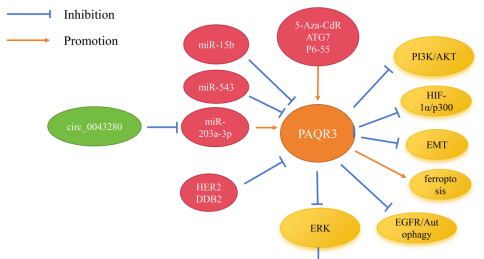
Progesterone and adiponectin receptor 3 (PAQR3) is a Golgi-localized seven-transmembrane protein that anchors rapidly accelerated fibrosarcoma kinase (Raf) and suppresses rat sarcoma/rapidly accelerated fibrosarcoma/mitogen-activated protein kinase kinase/extracellular signal-regulated kinase (Ras/Raf/MEK/ERK) signaling, thereby influencing cellular proliferation, differentiation, and metastasis. This review aims to summarize the expression patterns, regulatory mechanisms, key downstream pathways, and clinical significance of PAQR3 in cancer. We synthesized findings from published clinical and experimental studies, including in vitro assays and nude mouse xenograft models, that evaluate PAQR3 expression, function, and signaling interactions across various tumor types. Overall, PAQR3 is frequently downregulated in many cancers, potentially due to promoter methylation, and low expression levels are associated with adverse clinicopathologic features and reduced survival. Functionally, PAQR3 overexpression inhibits proliferation, colony formation, migration, invasion, and tumor growth, primarily through the inhibition of extracellular signal-regulated kinase (ERK) and phosphatidylinositol 3-kinase/protein kinase B (PI3K/AKT) pathways and modulation of epithelial-mesenchymal transition (EMT). Additionally, PAQR3 is linked to nuclear factor kappa B/tumor protein p53 (NF-κB/p53), epidermal growth factor/beta-catenin (EGF/β-catenin) signaling, autophagy, and nuclear factor erythroid 2–related factor 2/ferroptosis (Nrf2/ferroptosis). These effects are modulated by upstream regulators, including microRNA-543 (miR-543), circular RNA 0043280/microRNA-203a-3p (circ_0043280/miR-203a-3p), microRNA-15b (miR-15b), human epidermal growth factor receptor 2 (HER2), 5-aza-2′-deoxycytidine (5-Aza-CdR), autophagy-related 7 (ATG7), and damage-specific DNA binding protein 2 (DDB2). In conclusion, PAQR3 functions as a tumor suppressor and holds potential as a prognostic biomarker. Targeting PAQR3-related pathways may provide new therapeutic opportunities.
Citations
Downloads
References
Xu J, Zhang Z, Qian M, Wang S, Qiu W, Chen Z, et al. Cullin-7 (CUL7) is overexpressed in glioma cells and promotes tumorigenesis via NF-κB activation. J Exp Clin Cancer Res. 2020;39(1):59–59.
https://doi.org/10.1186/s13046-020-01553-7
Lin C, Wu Y, Qian Y, Li J, He Y, Yu H, et al. SATB2 promotes radiation resistance of esophageal squamous cell carcinoma by regulating epithelial-to-mesenchymal transition via the Wnt/β-catenin pathway. Front Oncol. 2025;15:1543426.
https://doi.org/10.3389/fonc.2025.1543426
Zhang Z, Mei Y, Hou M. Knockdown RBM15 inhibits colorectal cancer cell proliferation and metastasis via N6-methyladenosine (m6A) modification of MyD88 mRNA. Cancer Biother Radiopharm. 2022;37(10):976–986.
https://doi.org/10.1089/cbr.2021.0226
Yan Q, Sun Q, Feng Y, Hu Q, Zhu J. ATP1B3 may promote glioma proliferation and migration through MAPK/NF-κB signaling pathway. Front Oncol. 2025;15:1537687.
https://doi.org/10.3389/fonc.2025.1537687
Guo Q, Ke XX, Liu Z, Gao WL, Fang SX, Chen C, et al. Evaluation of the prognostic value of STEAP1 in lung adenocarcinoma and insights into its potential molecular pathways via bioinformatic analysis. Front Genet. 2020;11:242.
https://doi.org/10.3389/fgene.2020.00242
Lei L, Ling ZN, Chen XL, Hong LL, Ling ZQ. Characterization of the Golgi scaffold protein PAQR3, and its role in tumor suppression and metabolic pathway compartmentalization. Cancer Manag Res. 2020;12:353–362.
https://doi.org/10.2147/CMAR.S210919
Ma Z, Wang Y, Piao T, Li Z, Zhang H, Liu Z, et al. The tumor suppressor role of PAQR3 in osteosarcoma. Tumour Biol. 2015;36(5):3319–3324.
https://doi.org/10.1007/s13277-014-2964-z
Gao J, Ma XP, Deng FS, Jiang L, Jia WD, Li M. Associations of the BRAF V600E mutation and PAQR3 protein expression with papillary thyroid carcinoma clinicopathological features. Pathol Oncol Res. 2020;26(3):1833–1841.
https://doi.org/10.1007/s12253-019-00779-x
Tang SL, Gao YL, Hu WZ. PAQR3 inhibits the proliferation, migration and invasion in human glioma cells. Biomed Pharmacother. 2017;92:24–32.
https://doi.org/10.1016/j.biopha.2017.05.046
Liang X, Sun B, Han J, Zhao X, Liu Z. Expression and clinical significance of progesterone and adiponectin receptor family member 3 in lung cancer. Zhongguo Fei Ai Za Zhi. 2017;20(4):259–263.
Guo Q, Ke XX, Fang SX, Gao WL, Song YX, Chen C, et al. PAQR3 inhibits non-small cell lung cancer growth by regulating the NF-κB/p53/Bax axis. Front Cell Dev Biol. 2020;8:581919.
https://doi.org/10.3389/fcell.2020.581919
Li X, Li M, Chen D, Shi G, Zhao H. PAQR3 inhibits proliferation via suppressing PI3K/AKT signaling pathway in non-small cell lung cancer. Arch Med Sci. 2018;14(6):1289–1297.
https://doi.org/10.5114/aoms.2017.72220
Yu L, Zhou L, Cheng Y, Sun L, Fan J, Liang J, et al. MicroRNA-543 acts as an oncogene by targeting PAQR3 in hepatocellular carcinoma. Am J Cancer Res. 2014;4(6):897–906.
Wu HG, Zhang WJ, Ding Q, Peng G, Zou ZW, Liu T, et al. Identification of PAQR3 as a new candidate tumor suppressor in hepatocellular carcinoma. Oncol Rep. 2014;32(6):2687–2695.
https://doi.org/10.3892/or.2014.3532
Zhang C, Liu P, Huang J, Liao Y, Pan C, Liu J, et al. Circular RNA hsa_circ_0043280 inhibits cervical cancer tumor growth and metastasis via miR-203a-3p/PAQR3 axis. Cell Death Dis. 2021;12(10):888.
https://doi.org/10.1038/s41419-021-04193-7
Li RH, Zhang AM, Li S, Li TY, Wang LJ, Zhang HR, et al. PAQR3 gene expression and its methylation level in colorectal cancer tissues. Oncol Lett. 2016;12(3):1773–1778.
https://doi.org/10.3892/ol.2016.4843
Wang X, Li X, Fan F, Jiao S, Wang L, Zhu L, et al. PAQR3 plays a suppressive role in the tumorigenesis of colorectal cancers. Carcinogenesis. 2012;33(11):2228–2235.
https://doi.org/10.1093/carcin/bgs245
Song X, Zhang W, Yu N, Zhong X. PAQR3 facilitates the ferroptosis of diffuse large B-cell lymphoma via the regulation of LDLR-mediated PI3K/AKT pathway. Hematol Oncol. 2024;42(1):e3219.
https://doi.org/10.1002/hon.3219
Jin L, Tong L. PAQR3 inhibits proliferation and aggravates ferroptosis in acute lymphoblastic leukemia through modulation Nrf2 stability. Immun Inflamm Dis. 2021;9(3):827–839.
https://doi.org/10.1002/iid3.437
Qi LQ, Sun B, Yang BB, Lu S. MiR-15b facilitates breast cancer progression via repressing tumor suppressor PAQR3. Eur Rev Med Pharmacol Sci. 2020;24(2):740–748.
Li Z, Ling ZQ, Guo W, Lu XX, Pan Y, Wang Z, et al. PAQR3 expression is downregulated in human breast cancers and correlated with HER2 expression. Oncotarget. 2015;6(14):12357–12368.
https://doi.org/10.18632/oncotarget.3657
Chen J, Wang F, Xu J, He Z, Lu Y, Wang Z. The role of PAQR3 gene promoter hypermethylation in breast cancer and prognosis. Oncol Rep. 2016;36(3):1612–1618.
https://doi.org/10.3892/or.2016.4951
Bai G, Chu J, Eli M, Bao Y, Wen H. PAQR3 overexpression suppresses the aggressive phenotype of esophageal squamous cell carcinoma cells via inhibition of ERK signaling. Biomed Pharmacother. 2017;94:813–819.
https://doi.org/10.1016/j.biopha.2017.07.154
Bai G, Yang M, Zheng C, Zhang L, Eli M. Suppressor PAQR3 associated with the clinical significance and prognosis in esophageal squamous cell carcinoma. Oncol Lett. 2018;15(4):5703–5711.
https://doi.org/10.3892/ol.2018.8004
Zhou F, Wang S, Wang J. PAQR3 inhibits the proliferation and tumorigenesis in esophageal cancer cells. Oncol Res. 2017;25(5):663–671.
https://doi.org/10.3727/096504016X14761384026719
Wu YL, Hong LL, Ling ZN, Hu XY, Liu Z, Li P, et al. Golgi scaffold protein PAQR3 as a candidate suppressor of gastric cardia adenocarcinoma via regulating TGF-β/Smad pathway. J Clin Lab Anal. 2022;36(9):e24617.
https://doi.org/10.1002/jcla.24617
Ling ZQ, Guo W, Lu XX, Zhu X, Hong LL, Wang Z, et al. A Golgi-specific protein PAQR3 is closely associated with the progression, metastasis and prognosis of human gastric cancers. Ann Oncol. 2014;25(7):1363–1372.
https://doi.org/10.1093/annonc/mdu168
Zhang Y, Jiang X, Qin X, Ye D, Yi Z, Liu M, et al. RKTG inhibits angiogenesis by suppressing MAPK-mediated autocrine VEGF signaling and is downregulated in clear-cell renal cell carcinoma. Oncogene. 2010;29(39):5404–5415.
https://doi.org/10.1038/onc.2010.270
Cao Q, You X, Xu L, Wang L, Chen Y. PAQR3 suppresses the growth of non-small cell lung cancer cells via modulation of EGFR-mediated autophagy. Autophagy. 2020;16(7):1236–1247.
https://doi.org/10.1080/15548627.2019.1659654
Huang W, Guo W, You X, Pan Y, Dong Z, Jia G, et al. PAQR3 suppresses the proliferation, migration and tumorigenicity of human prostate cancer cells. Oncotarget. 2016;8(33):53948–53958.
https://doi.org/10.18632/oncotarget.9807
Zhao C, Li Y, Chen G, Wang F, Shen Z, Zhou R. Overexpression of miR-15b-5p promotes gastric cancer metastasis by regulating PAQR3. Oncol Rep. 2017;38(1):352–358.
https://doi.org/10.3892/or.2017.5673
Qiao S, Guo W, Liao L, Wang L, Wang Z, Zhang R, et al. DDB2 is involved in ubiquitination and degradation of PAQR3 and regulates tumorigenesis of gastric cancer cells. Biochem J. 2015;469(3):469–480.
https://doi.org/10.1042/BJ20150253
Guo W, You X, Xu D, Zhang Y, Wang Z, Man K, et al. PAQR3 enhances Twist1 degradation to suppress epithelial-mesenchymal transition and metastasis of gastric cancer cells. Carcinogenesis. 2016;37(4):397–407.
https://doi.org/10.1093/carcin/bgw013
Guo Q, Liu XL, Zhai K, Chen C, Ke XX, Zhang J, et al. The emerging roles and mechanisms of PAQR3 in human cancer: pathophysiology and therapeutic implications. Int J Gen Med. 2023;16:4321–4328.
https://doi.org/10.2147/IJGM.S422523
Zhai K, Miao XP, Ai SG, Guo Q, Zha RZ. Downregulation of PAQR3 expression predicts poor prognosis of patients with pan-cancer: a meta-analysis. Front Oncol. 2025;15:1574150.
https://doi.org/10.3389/fonc.2025.1574150
You X, Gai Y, Wang Z, Wang Y, Ye J, Cao Y, et al. Transcriptomic and functional validation reveals PAQR3/P6-55 as potential therapeutic targets in colon cancer. Biology (Basel). 2025;14(7):780.
https://doi.org/10.3390/biology14070780
Ullah R, Yin Q, Snell AH, Wan L. RAF–MEK–ERK pathway in cancer evolution and treatment. Semin Cancer Biol. 2022;85:123–154.
https://doi.org/10.1016/j.semcancer.2021.05.010
Huang X, Liu G, Guo J, Su Z. The PI3K/AKT pathway in obesity and type 2 diabetes. Int J Biol Sci. 2018;14(11):1483–1496.
https://doi.org/10.7150/ijbs.27173
Glaviano A, Foo ASC, Lam HY, Yap KCH, Jacot W, Jones RH, et al. PI3K/AKT/mTOR signaling transduction pathway and targeted therapies in cancer. Mol Cancer. 2023;22(1):138.
https://doi.org/10.1186/s12943-023-01827-6
Saitoh M. Involvement of partial EMT in cancer progression. J Biochem. 2018;164(4):257–264.
Downloads
Published
Issue
Section
Categories
License
Copyright (c) 2026 Yan Lv, Dan Li, Xiao-Fei Ren, Qiang Guo, Qiao-Ya Ren

This work is licensed under a Creative Commons Attribution 4.0 International License.