

The Effects of Inducible Nitric Oxide Synthase Inhibitor L-N6-(1-Iminoethyl) Lysine in Gentamicin-Induced Acute Tubular Necrosis in Rats
Abstract
The aim of this study was to investigate the role of inducible nitric oxide synthase (iNOS) in gentamicin-induced acute tubular necrosis in rats using the iNOS inhibitor L-N6-(1-iminoethyl) lysine (L-NIL). Wistar rats, both sexes (n=18), were equally divided into three groups. Gentamicin group received intraperitoneally (i.p.) gentamicin in 0,9 % NaCl at a dose of 80 mg/kg/day for five consecutive days. L-NIL+gentamicin group received L-NIL at a dose of 3mg/kg i.p. 36, 24 and 12 h before first dose of gentamicin. Control group received 0,9 % NaCl i.p. for five consecutive days at the equal volume as gentamicin group. Griess reaction was used for determination plasma level of NO. Semiquantitative histological analysis was used for the evaluation of kidney damage level. The plasma NO level and the level of kidney damage were statistically higher in gentamicin group in comparison to the control group (p=0,046). Application of L-NIL prior to gentamicin led to certain decrease in the plasma level of NO as well as in the level of kidney damage. Application of L-NIL, prior to gentamicin administration, did not provide complete protective effects of L-NIL on the kidney, which was demonstrated on kidney sections. The lack of anticipated protective effect of L-NIL on kidney tissue might be explained with the fact that we have used L-NIL prior but not during/after gentamicin administration. It would be necessary to examine the effects of L-NIL administration not only before, but as well during and possibly after the administration of gentamicin.
Keywords
nitric oxide inducible nitric oxide synthase gentamicin acute tubular necrosisFull text
Introduction
Nitric oxide (NO) is free radical gas with unique properties. NO can diffuse rapidly across membranes and transmit a signal over many cell lengths. These properties make NO useful as a rapidly transmitted messenger molecule (1). NO is involved in the regulation of many physiological processes, as well as in the pathophysiology of a number of diseases (2). It is synthesized enzymatically from L-arginine in numerous tissues and cell types by three structurally distinct isoforms of the enzyme, nitric oxide synthase (NOS). Two of these isoforms are expressed in a constitutive manner, predominantly in the vascular endothelium (eNOS) and in the nervous tissue (nNOS). Under normal physiological conditions, these constitutive forms of NOS generate low, transient levels of NO in response to intracellular calcium concentrations. These low levels of NO act to regulate blood pressure, platelet adhesion, gastrointestinal motility, bronchomotore tone and neurotransmission (3,4). The expression of the third isoform, inducible (iNOS), is induced by endotoxine and/or cytokines and generates high, sustained levels of NO. These elevated levels of NO, generated by iNOS, and resulting NO-derived metabolites cause cellular cytotoxicity and tissue damage and are thought to contribute to the pathophysiology of a number of humane diseases (5,6). Selective iNOS inhibitors, including L-N6-(1-iminoethyl) lysine - (L-NIL), have been shown to suppress the overproduction of NO in animal models of acute and chronic inflammation. Importantly, L-NIL was found to be orally active and also produces marked efficacy at doses that did not produce an elevation in systemic blood pressure, demonstrating in vivo selectivity. This suggests that selective iNOS inhibitor may have therapeutic potential for the treatment of diseases mediated by overproduction of NO (7,8). A significant role of NO in proximal tubule physiology and pathophysiology has been revealed by a series of in vivo and in vitro studies. Whether the proximal tubule produces NO under basal conditions is still controversial. However, evidences suggest that the proximal tubule is constantly exposed to NO that might include NO from non-proximal tubule sources. The proximal tubule is able to produce large quantities of NO under the influence of wide range of stimuli (nephrotoxic agents, hypoxia). Enhanced production of NO, perhaps depending on macrophage type inducible NO synthase, participates in toxic, hypoxic/ischemic tubular injury. In conclusion, NO plays a fundamental role in both physiology and pathophysiology of the proximal tubule (9).
Acute tubular necrosis is characterized pathologically by varying degree of tubule cell damage and death, usually resulting from prolonged renal ischemia or nephrotoxic agents (gentamicin). Gentamicin acts mainly in proximal tubular cells, where it is taken via organic anion transport system and it induces a high incidence of nephrotoxicity. The changes in NO production could contribute to the pathology of gentamicin-induced acute tubular necrosis (10). Pharmacological studies of NO’s role in renal failure have produced confusing and contradictory results. L-arginine analog NOS inhibitors have been shown to provide protection against hypoxia-induced renal injury (11). However, in radiocontrast toxicity-induced renal injury, NOS inhibitors can exacerbate the renal injury (12). Likewise, Ferrario at al. (13) found that inhibition of NO synthesis could worsen the degree of proteinuria in nephrotoxic nephritis. The use of NO donors suppressed the activation of stress factor activated pathway caused by hypoxia-induced acute renal failure, suggesting that NO acts as a negative feedback regulator of stress-induced cell activation (14). The purpose of our study was to investigate the role of iNOS in gentamicin-induced acute tubular necrosis in rats with the use of selective iNOS inhibitor L-NIL.
Materials and methods
Animals
Experiments were performed on Albino-Wistar rats (n=18), both sexes, weighting between 200 to 250 g. The local Ethic Committee gave the permission for the experiment. All animals were allowed one week of adaptation period before beginning of the experiment. Standard rat chow and tap water were given ad libitum. Animals were divided in three equal groups: Gentamicin, L-NIL+ gentamicin and control group and were housed in standard cages.
Experimental protocol
Rats were assigned randomly to three equal groups. The rats in Gentamicin group were injected intraperitoneally (i.p.) with gentamicin in 0,9 % NaCl at a dose of 80 mg/kg body weight/day for five consecutive days (n=6). The injections were given between 09:00 and 09:30 a.m. to minimize the circadian variation seen in gentamicin-induced nephrotoxicity (15). The second group of animals (L-NIL+gentamicin group) received gentamicin at the identical dose as in the previous group and additionally were given L-N6-(1-iminoethyl) lysine at a dose of 3mg/kg body weight i.p. 36, 24 and 12 h before first dose of gentamicin (n=6). Control animals were injected intraperitoneal^ (i.p.) with 0,9 % NaCl at the same volume as gentamicin-treated rats, for a period of five consecutive days (n=6).
Surgical procedure
Twenty four hours after the last injection of gentamicin, the animals were anesthetized with ether inhalation and the front wall of the abdominal cavity was removed. Blood samples were collected from the bifurcation of the aorta for the plasma NO level measurement. The kidneys were removed, vertically divided into two sections and fixed in 10% formalin and then embedded in paraffin wax for light microscopy.
NO measurement
The plasma level of NO was determined by measuring nitrite concentrations, a stable metabolic product of NO with oxygen. Conversion of NO 3 into NO 2 was done with elementary zinc. NO ğ concentration in plasma was determined by classic colorimetrical Griess reaction (16). Absorbency was measured at 546 nm. The results were expressed as μmol/dm3.
Histopathology
Sections of kidney were cut and stained with hematoxylin-eosin (H-E) and Periodic acid-Schiff (PAS). The light microscopic evaluation of the kidney sections was done according to Houghton et al. (17). The changes were limited to the tubulointerstitial areas and were graded as follows: 0=normal; 1=areas of focal granulovacuolar epithelial cell degeneration and granular debris in the tubular lumen with or without evidence of desquamation in small foci (tubular epithelium desquamation affects <1% of all tubules); 2= tubular epithelial necrosis and desquamation easily seen but involving less than half of cortical tubules; 3= more than half of the proximal tubules showing necrosis and desquamation, but intact tubules are easily identified and 4=complete or almost complete proximal tubular necrosis.
Statistical analysis
Statistical analyses were performed using SPSS software, version 12.0. All values are reported as mean ± SEM. The Levene test used analysis of variance homogeneity between groups. Comparison between the groups were preformed by one-way analysis of variance (ANOVA) followed by multiple comparison Bonferroni test. Association between plasma level of NO and histopathological injury score was tested with Spearman’s rank correlation analysis. Statistical differences were considered significant if the p value was <0,05.
Results
Plasma NO level was statistically different between the groups (p=0,048). Using multiple comparison test the only significant difference was found between the control and gentamicin group (p=0,046) while no significant difference was found between control and L-NIL+gentamicin group and between gentamicin and L-NIL+gentamicin group (Figure 1).
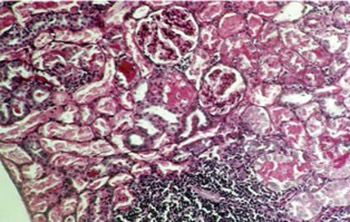
The specimens of kidney taken from the gentamicin administrated rats showed extensive tubular damage. Superficial cortical tubules revealed degeneration and necrosis of epithelial cells. In the proximal tubular lumen a significant quantity of desquamated epithelial cells debris was present. Amorphous PAS positive cylinders were present in some distal tubules. Brushborder membranes of almost all cells were disrupted. Intensive focal mononuclear cell inflammation was appeared in interstitium. Glomeruli were showed excess in mesangial matrix, accumulation hyaline materials and change in size of Bowman’s space (Figure 2A and 2B). The kidney specimens from the L-NIL+gentamicin group had an intermediate level of damage. The cortical proximal tubules revealed degeneration and necrosis of epithelial cells with intact basal membranes. Brush-border membranes were disrupted in many tubules, but the damage was less severe than the one found in the gentamicin group. Some vacuolization and swelling were observed in the tubular epithelial cells. The nuclei of these cells were intact. The lumen of distal tubule was obstructed by hyaline casts, while glomeruli were showed less mesangial matrix production and resolving early description changes of Bowman’s space. Interstitial inflammation and oedema were more slightly (Figure 3A and 3B).
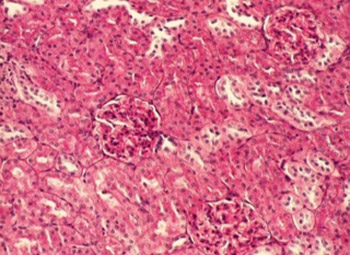
Kidney specimens from control animals showed the normal structure of healthy proximal tubules with abundant luminal brush-border membranes. Distal tubules and glomeruli also showed normal structure (Figure 4A and 4B). In the control group all specimens of kidney tissue were not showed changing (score grade 0). In the L-NIL+gentamicin group two samples of kidney tissue were grade 4, one was grade 3 and three were grade 2. In the gentamicin group, three kidney samples were grade 4, two were grade 3 and one was grade 2 (Table 1).
Numbers indicate the specimens having the same respective grading criteria in each group. Using Spearman rank correlation analysis a positive, statistically significant, correlation was found between histopathological injury score and plasma NO level (r=0,77; p<0,001) in total experimental sample. There was a statistically significant positive correlation between histopathological injury score and plasma NO level in the L-NIL + gentamicin group and also in the gentamicin group (r=0,93; p<0,01 for both groups) (Figure 5).
Discussion
The experimental models of toxic ATN caused by different agents including uranyl-nitrate, mercury chloride, radiocontrast or nephrotoxic agents such as aminoglycosides (18-21) were used for clarification of underlying pathophysiological mechanisms of ATN and for identification of new therapeutic strategies. Most of the studies so far have shown that in the pathogenesis of toxic renal injury, NO could have certain role. It is not still completely certain how, and to what extent, this gas contributes to the development of tubular damage (1). The results of our study showed that the plasma level of NO was significantly higher in rats with ATN caused by gentamicin compared to the control group.
The observed increase of NO plasma level is in accordance with results of Chatterjee et al. (22), who reported increased NO plasma level in rats with renal ischemia/reperfusion (I/R) - induced ATN. To establish the role of NO in renal ATN, NO donors and NO inhibitors (selective and non-selective) were used. Results of the most of the studies, so far, have shown that use of NOS inhibitors leads to a decrease of NO synthesis (22). The decrease of NO production was observed when NOS inhibitor was applied before as well as during an induction of necrosis. Further progression of kidney damage, especially the damage of proximal tubule cells, was stopped with the use of NOS inhibitors. It is supposed that the induction of iNOS and consequent increased NO synthesis plays an important role in the progression of ATN caused by toxic agents (18,21). Our results have shown that plasma NO level in animals, which were treated with iNOS inhibitor (L-NIL) before the induction of ATN by gentamicin, was lower in the comparison with the plasma NO level in animals with ATN caused by gentamicin without the use of iNOS inhibitor, but the observed difference was not statistically significant. Application of selective iNOS inhibitor just prior to induction of ATN with gentamicin in the L-NIL+gentamicin group led to certain decrease in the plasma level of NO and in the level of kidney damage compared with gentamicin group. However, compared with the control group, plasma NO level and level of kidney damage were higher in L-NIL+gentamicin group. These results are not in a complete accordance with the results of other authors. Possible cause of this discrepancy is the fact that different protocols were used (type and quantity of used inhibitor, time of inhibitor application in relation to the application of toxic agent). In the studies conducted so far, L-NIL was administrated before, during and after renal damage in ATN caused by different agents (18,22). In our study, we decided to administrate L-NIL before the induction of kidney tubular necrosis. L-NIL was administrated 36, 24 and 12 hours prior to gentamicin application in a single dose of 3 mg/kg. Yanagisawa et al. (18) in their experiment of ATN induced by HgCl2, have used aminoguanidine, a non-selective NOS inhibitor. They administrated aminoguanidine before the induction of toxic kidney damage by HgCl2 and they followed the effects of its application on the expression of iNOS mRNA and iNOS protein. Pretreatment of rats with aminoguanidine suppressed the development of proximal tubule epithelial cell injury and decreased iNOS mRNA and iNOS protein in rats with HgCl2 induced ATN. The results of Chatterjee et al. (22) suggest that L-NIL and aminoethyl-isothiourea (AE-ITU) reduce the renal dysfunction and injury associated with I/R of the kidney, via inhibition of iNOS activity and subsequent reduction of NO generation. Schwartz et al. (23) have investigated the effects of application of selective (L-NIL) and non-selective iNOS inhibitor nitro-L-argin- ine-methylester (L-NAME), before, during and immediately after the induction of tubular kidney damage by lipopolysaccharide (LPS). Their results have shown that in animals in which LPS was administrated, NO excretion in urine was increased. Excretion of NO was decreased when animals received together with LPS either selective or nonselective NOS inhibitor. These results have confirmed that the increased excretion of NO in urine is a consequence of increased NOS activity in the conditions of kidney damage caused by LPS. In literature L-NIL is described as extremely selective iNOS inhibitor in vitro (24) and in vivo (25) and it has been used in the evaluation of iNOS roles in a number of studies (23,26). In recent papers, it has been established that 3 mg/kg dose of L-NIL decreases renal damage caused by use of LPS (23,27), as well as damage caused by renal I/R injury (28). Protective role of L-NIL was not observed by Walker et al. (28) after the administration of higher doses of L-NIL (10mg/ kg) in a kidney damage induced by I/R injury. This result may reflect a loss of isoform selectivity of L-NIL at higher doses. The apparent decrease of NO 2 and NO 3 concentration in plasma after the 10 mg/kg dose of L-NIL in a group of animals without the kidney damage, supports the observation that higher doses of L-NIL may inhibit basal NO formation (28). Since pharmacokinetics of L-NIL is still unknown, it is necessary to determine its optimal dose and time of application in relation to administration of noxious agents for the complete assessment of this agent’s usefulness.
Conclusion
In conclusion, the results of our study as well as the results of previous studies are suggesting that the usage of selective iNOS inhibitor, L-NIL, has protective role in gentamicin-induced ATN. However, we would like to emphases that in the prevention of further kidney damage very important role has not only the dose of L-NIL but as well the time of its application.
Our results have shown that administration of L-NIL prior to induction of ATN with gentamicin in rats did not provide complete protective effects. Still, because we observed decrease in NO production and in the level of kidney damage, it would be necessary to examine the effects of L-NIL administration not only before, but as well during and possibly after the administration of gentamicin.
List of abbreviations
NO - nitric oxide
L-NIL - L-N6-(1-iminoethyl) lysine
iNOS - inducible nitric oxide synthase
eNOS - endothelial nitric oxide synthase
nNOS - neuronal nitric oxide synthase
ATN - acute tubular necrosis
i.p. - intraperitoneally
NOS - nitric oxide synthase
H-E - hematoxylin-eosin
PAS - Periodic acid-Schiff
AE-ITU - aminoethyl-isothiourea
L-NAME - nitro-L-arginine-methylester
LPS - lipopolysaccharide
I/R - ischemia/reperfusion
References
- Orida N.K, Lai C.S. Nitric oxide and renal patient. Dial. Transplant 2000;29(4):174–185.
- Moncada S, Palmer R.M.J, Higgs E.A. Nitric oxide: physiology, pathophysiology and pharmacology. Pharmacol. Rev 1991;43(2):109–142.
- Griscavage J.M, Rogers N.E, Sherman M.P, Ignarro L.J. Inducible nitric oxide synthase from a rat alveolar macrophage cell line is inhibited by nitric oxide. J. Immunol 1993;151(11):6329–6337.
- Gorren A.C.F, Mayer B. The versatile and complex enzymology of nitric oxide synthase. Biochem. (Moscow) 1998;63(7):734–870.
- Hobss A, Higgs A, Moncada S. Inhibition of nitric oxide synthase as a pontential therapeutic target. Ann. Rev. Pharmacol. Toxicol 1999;39:191–220.
- Salvemini D, Misko T.P, Masferrer J.L, et al. Nitric oxide activates cyclooxygenases enzymes. Proc. Natl. Acad. Sci. USA 1993;90:7240–7244.
- Salvemini D, Wang ZQ, Bourdon DM, et al. Evidence of perox-initrite involvement in the carrageenan-induced rat paw oedema. Eur J Pharmacol 1996;303:217–202.
- Connor J.R, Manning P.T, Settle S.L, et al. Suppression of adjuvant induced arthritis by selective inhibition of inducible nitric oxide synthase. Eur. J. Pharmacol 1995;273:15–24.
- Liang M, Knox F.G. Production and functional roles of nitric oxide in the proximal tubule. Am. J. Physiol 2000;278(5):R1117–1124.
- Bennett W.M. Drug and the kidney. In: Textbook of renal disease 1994:325–342.
- Yu L, Gengaro P.E, Niedergerger M, et al. Nitric oxide: A mediator in rat tubular hypoxia/reoxygenation injury. Proc. Natl. Acad. Sci. USA 1994;91:1691–1695.
- Agmon Y, Pegel H, Greenfeld Z, et al. Nitric oxide and prostanoids protect the renal outer medulla from radiocontrast toxicity in the rat. J. Clin. Invest 1994;94:1069–1075.
- Ferrario R, Takahashi K, Fogo A, et al. Consequences of acute nitric oxide synthesis inhibition in experimental glomerulone-phritis. J. Am. Soc. Nephrol 1994;4:1847–1854.
- Sogawa K, Numayama-Tsuruta K, Ema M, Abe H, Abe M, Fujii-Kuriyama Y, et al. Inhibition of hypoxia-inducible factor 1 activity by nitric oxide donors in hypoxia. Proc. Natl. Acad. Sci. USA 1998;95:7368–7373.
- Pariat C, Courtois P, Cambar J, et al. Cicardian variation in the renal toxicity of gentamicin in rats. Toxicol. Lett 1988;40:175–182.
- Green L.C, Wagner D.A, Glogowski J, et al. Analysis of nitrate, nitrite and 14N nitrate in biological fluids. Anal. Biochem 1982;126:131–138.
- Houghton D.C, Plamp C.E, DeFehr J.M, et al. Gentamicin and tobramycin nephrotoxicity: a morphologic and functional comparison in the rat. Am. J. Pathol 1978;93:137–151.
- Yanagisawa H, Nodera M, Wada O. Inducible nitric oxide synthase expression in mercury chloride-induce acute tubular necrosis. Industrial Health 1998;36(4):324–330.
- Erdem A, Gündogan N.U, Usubütün A, et al. The antioxidant action of N-acetylcystein on gentamicin-induced acute tubular necrosis in rats. Gazi Med. J 1999;10:21–28.
- Erdem A, Gündogan N.U, Usubütün A, et al. The protective effect of taurine against gentamicin-induced acute tubular necrosis in rat. Nephrol. Dial. Transplant 2000;15:1175–1182.
- Yanagisawa H. HgCl2-induced acute renal failure and its pathophysiology. Nippon. Eiseigaku Zasshi 1998;52(4):617–624.
- Chatterjee P.C, Patel N.S.A, Kvale E.O, et al. Inhibition of inducible nitric oxide synthase reduces renal ischemia/reperfusion injury. Kidney Int 2002;61:862–871.
- Schwartz D, Mendonca M, Schwartz I, et al. Inhibition of constitutive nitric oxide synthase (NOS) by nitric oxide generated by inducible NOS after lipopolisaccharide administration provokes renal dysfunction in rats. J. Clin. Invest 1997;100(2):439–448.
- Moore W.M, Webber R.K, Jerome G.M, et al. L-N6-(l-iminoethyl) lysine: A selective inhibitor of inducible nitric oxide synthase. J. Med. Chem 1994;37:3886–3888.
- Faraci W.S, Nagel A.A, Verdries K.A, et al. 2-Amino-4-methylpyridine as a potent inhibitor of inducible NO synthase activity in vitro and in vivo. Br. J. Pharmacol 1996;119:1101–1108.
- Connor J.R, Manning P.T, Settle S.L, et al. Suppression of adjuvant induced arthritis by selective inhibition of inducible nitric oxide synthase. Eur. J. Pharmacol 1995;273:15–24.
- Zhang C, Walker L.M, Hinson J.A, Mayeux P.R. Oxidant stress in rat liver after lipopolysaccharide administration: Effect of inducible nitric oxide synthase inhibition. Pharmacol. Exp. Therap 2000;293(3):968–972.
- Walker L.M, Walker P.D, Imam S.Z, et al. Evidence for peroxynitrite formation in renal ischemia-reperfusion injury: studies with the inducible nitric oxide synthase inhibitor L-N6-(1-iminoethyl) lysine. J. Pharmacol. Exp. Therap 2000;295(1):417–422.
About this article
Correspondence
*Corresponding author
Copyright
Copyright: © 2007 ABMSFBIH
Downloads
References
Orida N.K, Lai C.S. Nitric oxide and renal patient. Dial. Transplant. 2000;29(4):174-185.
Moncada S, Palmer R.M.J, Higgs E.A. Nitric oxide: physiology, pathophysiology and pharmacology. Pharmacol. Rev. 1991;43(2):109-142. DOI: https://doi.org/10.1016/S0031-6997(25)06663-3
Griscavage J.M, Rogers N.E, Sherman M.P, Ignarro L.J. Inducible nitric oxide synthase from a rat alveolar macrophage cell line is inhibited by nitric oxide. J. Immunol. 1993;151(11):6329-6337. DOI: https://doi.org/10.4049/jimmunol.151.11.6329
Gorren A.C.F, Mayer B. The versatile and complex enzymology of nitric oxide synthase. Biochem. (Moscow). 1998;63(7):734-870.
Hobss A, Higgs A, Moncada S. Inhibition of nitric oxide synthase as a pontential therapeutic target. Ann. Rev. Pharmacol. Toxicol. 1999;39:191-220. DOI: https://doi.org/10.1146/annurev.pharmtox.39.1.191
Salvemini D, Misko T.P, Masferrer J.L, et al. Nitric oxide activates cyclooxygenases enzymes. Proc. Natl. Acad. Sci. USA. 1993;90:7240-7244. DOI: https://doi.org/10.1073/pnas.90.15.7240
Salvemini D, Wang ZQ, Bourdon DM, et al. Evidence of perox-initrite involvement in the carrageenan-induced rat paw oedema. Eur J Pharmacol. 1996;303:217-202. DOI: https://doi.org/10.1016/0014-2999(96)00140-9
Connor J.R, Manning P.T, Settle S.L, et al. Suppression of adjuvant induced arthritis by selective inhibition of inducible nitric oxide synthase. Eur. J. Pharmacol. 1995;273:15-24.
Liang M, Knox F.G. Production and functional roles of nitric oxide in the proximal tubule. Am. J. Physiol. 2000;278(5):R1117-1124. DOI: https://doi.org/10.1152/ajpregu.2000.278.5.R1117
Bennett W.M, Whitworth J.A, Lawrence J.R, Kincaid S.P. Drug and the kidney. In: Textbook of renal disease. 1994:325-342.
Yu L, Gengaro P.E, Niedergerger M, et al. Nitric oxide: A mediator in rat tubular hypoxia/reoxygenation injury. Proc. Natl. Acad. Sci. USA. 1994;91:1691-1695. DOI: https://doi.org/10.1073/pnas.91.5.1691
Agmon Y, Pegel H, Greenfeld Z, et al. Nitric oxide and prostanoids protect the renal outer medulla from radiocontrast toxicity in the rat. J. Clin. Invest. 1994;94:1069-1075. DOI: https://doi.org/10.1172/JCI117421
Ferrario R, Takahashi K, Fogo A, et al. Consequences of acute nitric oxide synthesis inhibition in experimental glomerulone-phritis. J. Am. Soc. Nephrol. 1994;4:1847-1854. DOI: https://doi.org/10.1681/ASN.V4111847
Sogawa K, Numayama-Tsuruta K, Ema M, Abe H, Abe M, Fujii-Kuriyama Y, et al. Inhibition of hypoxia-inducible factor 1 activity by nitric oxide donors in hypoxia. Proc. Natl. Acad. Sci. USA. 1998;95:7368-7373. DOI: https://doi.org/10.1073/pnas.95.13.7368
Pariat C, Courtois P, Cambar J, et al. Cicardian variation in the renal toxicity of gentamicin in rats. Toxicol. Lett. 1988;40:175-182. DOI: https://doi.org/10.1016/0378-4274(88)90159-2
Green L.C, Wagner D.A, Glogowski J, et al. Analysis of nitrate, nitrite and 14N nitrate in biological fluids. Anal. Biochem. 1982;126:131-138. DOI: https://doi.org/10.1016/0003-2697(82)90118-X
Houghton D.C, Plamp C.E, DeFehr J.M, et al. Gentamicin and tobramycin nephrotoxicity: a morphologic and functional comparison in the rat. Am. J. Pathol. 1978;93:137-151.
Yanagisawa H, Nodera M, Wada O. Inducible nitric oxide synthase expression in mercury chloride-induce acute tubular necrosis. Industrial Health. 1998;36(4):324-330. DOI: https://doi.org/10.2486/indhealth.36.324
Erdem A, Gündogan N.U, Usubütün A, et al. The antioxidant action of N-acetylcystein on gentamicin-induced acute tubular necrosis in rats. Gazi Med. J. 1999;10:21-28.
Erdem A, Gündogan N.U, Usubütün A, et al. The protective effect of taurine against gentamicin-induced acute tubular necrosis in rat. Nephrol. Dial. Transplant. 2000;15:1175-1182. DOI: https://doi.org/10.1093/ndt/15.8.1175
Yanagisawa H. HgCl2-induced acute renal failure and its pathophysiology. Nippon. Eiseigaku Zasshi. 1998;52(4):617-624. DOI: https://doi.org/10.1265/jjh.52.618
Chatterjee P.C, Patel N.S.A, Kvale E.O, et al. Inhibition of inducible nitric oxide synthase reduces renal ischemia/reperfusion injury. Kidney Int. 2002;61:862-871. DOI: https://doi.org/10.1046/j.1523-1755.2002.00234.x
Schwartz D, Mendonca M, Schwartz I, et al. Inhibition of constitutive nitric oxide synthase (NOS) by nitric oxide generated by inducible NOS after lipopolisaccharide administration provokes renal dysfunction in rats. J. Clin. Invest. 1997;100(2):439-448. DOI: https://doi.org/10.1172/JCI119551
Moore W.M, Webber R.K, Jerome G.M, et al. L-N6-(l-iminoethyl) lysine: A selective inhibitor of inducible nitric oxide synthase. J. Med. Chem. 1994;37:3886-3888. DOI: https://doi.org/10.1021/jm00049a007
Faraci W.S, Nagel A.A, Verdries K.A, et al. 2-Amino-4-methylpyridine as a potent inhibitor of inducible NO synthase activity in vitro and in vivo. Br. J. Pharmacol. 1996;119:1101-1108. DOI: https://doi.org/10.1111/j.1476-5381.1996.tb16010.x
Connor J.R, Manning P.T, Settle S.L, et al. Suppression of adjuvant induced arthritis by selective inhibition of inducible nitric oxide synthase. Eur. J. Pharmacol. 1995;273:15-24. DOI: https://doi.org/10.1016/0014-2999(94)00672-T
Zhang C, Walker L.M, Hinson J.A, Mayeux P.R. Oxidant stress in rat liver after lipopolysaccharide administration: Effect of inducible nitric oxide synthase inhibition. Pharmacol. Exp. Therap. 2000;293(3):968-972. DOI: https://doi.org/10.1016/S0022-3565(24)39321-8
Walker L.M, Walker P.D, Imam S.Z, et al. Evidence for peroxynitrite formation in renal ischemia-reperfusion injury: studies with the inducible nitric oxide synthase inhibitor L-N6-(1-iminoethyl) lysine. J. Pharmacol. Exp. Therap. 2000;295(1):417-422. DOI: https://doi.org/10.1016/S0022-3565(24)38917-7
Article files
Additional Files
Accepted 2018-01-19
Published 2007-11-20
Publication details
- Citation
- Vol. 7 No. 4 (2007), pp. 345-351
- Language
- EN
- License
- CC BY 4.0
- Section
- Biochemistry
- Categories
- Research articles, Biochemistry, Pharmacology
How to cite (Vancouver)
Avdagić N, Nakaš-Ićindić E, Rašić S, Hadžović-Džuvo A, Začiragić A, Valjevac A. The Effects of Inducible Nitric Oxide Synthase Inhibitor L-N6-(1-Iminoethyl) Lysine in Gentamicin-Induced Acute Tubular Necrosis in Rats. Biomol Biomed. 2007;7(4):345-351. https://doi.org/10.17305/bjbms.2007.3025